On June 1st 2026, a high-level conference was held in Brussels at the premises of the European Economic and Social Committee (EESC). The event was organised by Confrontations Europe and the European Research Platform on Energy, in close partnership with the Climate Law and the EESC. Entitled « Designing of CfDs for Nuclear New Build », the conference brought together an outstanding panel of academics, regulators, policymakers and industry representatives to discuss a key issue for the future of the European Union’s energy sector: long-term price support mechanisms, and more specifically the design of Contracts for Difference (CfDs) for new nuclear projects.
The discussions benefited from contributions by leading experts, including Guillaume Dezobry, Associate Professor at the University of Amiens and Partner at EY Société d’Avocats in Paris; Christopher Jones, Professor of Energy Law and Policy at the European University Institute and the Florence School of Regulation; Marcin Kaminski, Head of Regulatory Risk at Polskie Elektrownie Jądrowe; Fabien Roques, Executive Vice President at Compass Lexecon and Associate Professor at Université Paris-Dauphine; Laurent Kueny, Director of Energy at the French Directorate-General for Energy and Climate (DGEC); and Charles Weymuller, Chief Economist at EDF. Their contributions addressed the legal, economic, regulatory and industrial challenges associated with implementing Contracts for Difference in the context of developing new nuclear capacity in Europe.
Against a European backdrop shaped by the pursuit of stronger industrial and digital sovereignty, the objective of achieving climate neutrality by 2050, and the need to enhance resilience in the face of global geopolitical shocks, the financial structuring of low-carbon investments has emerged as a cornerstone of both national and European public policies. The discussions throughout the morning provided an in-depth analysis of the dual nature of CfDs: while they serve as a powerful instrument for reducing investment risk and stabilising revenues, they do not eliminate the intrinsic risks associated with large-scale industrial projects. Rather, they facilitate a strategic and complex redistribution of financial risk among public authorities, end consumers and industrial stakeholders.
In his opening remarks, Michel Derdevet, President of Confrontations Europe, highlighted the importance of the interdisciplinary cooperation undertaken jointly by the University of Pau and Pays d’Adour , University Paris-Dauphine PSL, the Maison Française d’Oxford, and the European Federation of Energy Law Associations (EFELA). This network of excellence provides essential legal and economic insights into the ongoing energy transitions.
Mr Derdevet emphasised that this discussion is taking place at a pivotal moment for Europe. The continent is no longer merely debating financing mechanisms but is seeking to lay the foundations of a resilient, competitive and decarbonised electricity system. It is within this context that Small Modular Reactors (SMRs) and Advanced Modular Reactors (AMRs) have become central reference points.
At the European level, several decisive milestones have been reached, notably the launch by the European Commission in 2024 of the European Industrial Alliance on SMRs, with the objective of achieving effective industrial deployment by the early 2030s. In October 2024, the selection of an initial set of nine working groups¹ marked the transition from theoretical concepts to concrete industrial planning. These modular technologies offer several major advantages: the production of firm low-carbon electricity and heat, a reduced land footprint, enhanced operational flexibility, and lower entry costs compared with traditional large-scale nuclear projects. They therefore constitute a complementary solution to conventional nuclear infrastructure.
At the same time, the resurgence of large-scale nuclear projects in several Member States — notably in Poland and France with respectively 3.75 GW and 10 GW of new nuclear capacity — reflects a profound paradigm shift. Nuclear energy is now widely recognised as an essential contributor to the systemic stability of the European electricity grid. Finally, the publication last December of the European Commission’s updated guidelines on two-way CfDs² provides a valuable technical framework regarding contract categories and reference price modelling.
Opening Address by Laurent Kueny
Speaking in his capacity as Director of Energy (DGEC) of the French Ministry for Ecological Transition, Laurent Kueny immediately placed the technical issue of Contracts for Difference within its broader geopolitical context. He recalled that a single drone attack in the Middle East is sufficient to trigger an immediate surge in global oil prices, directly affecting Europe’s energy bill. In 2026, Europe’s security of energy supply remains structurally exposed to external risks.
France is well acquainted with this reality: its historic nuclear fleet was developed in the 1970s as a direct response to the first oil crisis, and contemporary crises continue to validate the long-term relevance of this strategic choice. As evidence, French electricity futures prices for 2027 remain around €55/MWh, largely insulated from international volatility, thereby providing lasting protection for French consumers.
At the level of the European Union, the assessment is stark: in 2023, the EU still imported nearly 58% of its total energy consumption, primarily in the form of fossil fuels, notably oil and natural gas. Reducing this dependency is therefore not merely a climate imperative; it is also an essential condition for ensuring the continent’s security of supply and macroeconomic resilience.
This is why many Member States are now returning to nuclear energy, a trend confirmed during the Nuclear Energy Summit held in Paris last February and supported by the European Commission’s Nuclear Illustrative Programme (PINC). According to the PINC projections, installed nuclear capacity in the European Union is expected to increase from 98 GW in 2025 to approximately 109 GW by 2050. The same report estimates that investment needs will amount to €241 billion by 2050 to extend the operational life of existing reactors and construct new large-scale units.
Mr Kueny emphasised the magnitude of the financial challenge: nuclear energy is an extremely capital-intensive industry, characterised by lengthy construction phases and substantial risks. Private capital markets are generally unable to absorb multi-billion-euro exposures over several decades in the face of wholesale price volatility. It is at this point that the two-way CfD changes status: from a simple financial arrangement, it becomes an instrument of strategic sovereignty. By guaranteeing a predictable strike price, the CfD significantly reduces the cost of capital. This rationale was precisely what guided the European Council when nuclear energy was incorporated into the reform of the European electricity market design.
Nevertheless, Mr Kueny was keen to highlight three fundamental limitations:
1. CfDs are necessary but insufficient : A CfD only guarantees a price once the power plant has entered commercial operation. However, a project must secure its financing 10 to 15 years earlier, during the construction phase. While a CfD stabilises future revenues, it does not finance the construction itself. To become bankable, a project requires a comprehensive financing package combining state-backed concessional loans, public guarantees, or mechanisms such as the Regulated Asset Base (RAB) model to manage construction risk.
2. Intergenerational balance : A CfD effectively shifts the financial burden onto future consumers who will ultimately use the electricity produced. Paradoxically, today’s consumers benefit from low-cost electricity generated by a fully amortised historical fleet, while contributing only marginally to the financing of its replacement, as EDF’s current revenues are structurally insufficient to cover future investment needs.
3. The future of the marginal pricing market : If all future low-carbon generation capacity — both nuclear and renewable — is removed from market signals through guaranteed-price CfDs, what residual role will remain for a wholesale electricity market based on marginal-cost pricing? This question is not merely theoretical; it lies at the heart of the future design of the European electricity market.
To conclude, Laurent Kueny outlined the key pillars of the French financing model notified to the European Commission last November for the construction of six EPR2 reactors, representing an estimated investment of more than €100 billion in current prices over the period 2027–2043. The model is based on three components: a subsidised public loan covering at least 60% of construction costs, a 40-year two-way CfD, and a risk-sharing mechanism between the French State and the energy company EDF to address construction risks. He emphasised the complexity of discussions with the Directorate-General for Competition (DG COMP), noting that assessing a nuclear project over the 2040–2080 horizon requires substantial and uncertain assumptions regarding the evolution of the energy mix, the pace of electrification, grid reinforcement, and cross-border interconnections.
Panel Discussion 1 : The lessons that can be drawn from the Commission’s guidance on CfD design
The first panel discussion, moderated by Professor Christopher Jones, sought to analyse the technical implications and economic subtleties of the European Commission’s recent guidance.
In his introductory remarks, Professor Jones noted, somewhat ironically, that a combined reading of the Electricity Market Design reform, the Climate, Environmental Protection and Energy Aid Guidelines (CEEAG)³, and the Clean Industrial State Aid Framework (CISAF)⁴ could essentially be summarised in a single rule: for any new nuclear project seeking public support, a two-way CfD is now the only legally permissible mechanism. Consequently, the real jurisprudence and practical rules are being developed on a case-by-case basis through the Commission’s individual notification decisions.
The Reference Price Issue: Insights from Marcin Kaminski
Marcin Kaminski, Assistant Professor at the University of Warsaw and Head of Regulatory Risk at BEJ (the special purpose entity established for Poland’s first nuclear project), focused his presentation on the modelling of the reference price in long-term contracts. From the perspective of the contract designer, the choice of reference price reflects two distinct approaches: either a purely procedural approach aimed at avoiding errors, or a more proactive approach that views the CfD as an opportunity to correct systemic market failures. In his view, nuclear energy must unequivocally adopt this proactive approach.
The underlying economic assumption is that investors exhibit a strong degree of risk aversion; consequently, they will adapt their arbitrage behaviour strictly according to the mathematical formula chosen for the financial settlement mechanism is therefore of critical importance. If the selected reference price is based solely on the day-ahead market price, operators will be financially incentivised to sell all of their output on this single time horizon. Any deviation from this strategy, or any attempt to sell electricity through forward contracts, would expose them to uncovered basis risk, which is unacceptable for investments of such a long duration. Experience with CfDs in the renewable energy sector has, moreover, revealed numerous methodological flaws that developers have exploited to maximise their returns at the expense of regulators.
According to Marcin Kaminski, adopting a more proactive approach offers a major opportunity: supporting the development of electricity forward markets, which have been identified by the European Union Agency for the Cooperation of Energy Regulators (ACER) as a widespread market failure across Europe due to their structural lack of liquidity beyond two or three years. Unlike intermittent renewable energy sources, the stable and dispatchable production profile of nuclear power plants is ideally suited to supporting long-term electricity markets through annual or multi-year contracts. This approach is, moreover, explicitly recommended in the European Commission’s guidelines.
Mr Kaminski outlined four essential design principles for establishing a robust and incentive-compatible reference price mechanism:
1. Ex Post Calculation : An ex post calculation method is preferable to an ex ante approach because it eliminates uncertainty and protects the system against speculative behaviour and market manipulation.
2. An Extended Reference Period : For financial settlement purposes, the use of annual or semi-annual averages is strongly recommended. Daily settlement periods should be explicitly excluded in order to eliminate any possibility of short-term market manipulation.
3. An Exogenous Reference Price : The reference price should be calculated on the basis of a basket of actual market price indices that are independent of the operator. Under such a system, if the operator succeeds in selling electricity above the average reference price through an optimised commercial strategy, it retains the additional revenue, thereby preserving incentives for market efficiency.
4. The Integration of Forward Hedging Products : This represents the principal innovation introduced in the Polish project and has subsequently been incorporated into both the French and Czech notifications, signalling the emergence of a common European model.
Financial and Technical Modulation Concepts: The Perspective of Guillaume Dezobry
Guillaume Dezobry, Associate Professor at the University of Amiens and Partner at EY Law, focused his legal analysis on what he described as the « produce and forget » phenomenon. Under a traditional production-based CfD, the operator automatically receives the strike price for every MWh injected into the grid, regardless of prevailing market conditions. As a result, the operator has no incentive to respond to the actual needs of the electricity system.
This approach has been significantly challenged by Regulation (EU) 2024/1747⁵, which requires State aid contracts to preserve incentives for operators to participate efficiently in the market and to adapt their generation, maintenance schedules and bidding strategies according to market conditions. The recitals of the Regulation explicitly state that operators should cease production whenever market prices fall below their variable operating costs.
On this point, Mr Dezobry emphasised a fundamental physical distinction between nuclear power and renewable energy sources. Whereas the European Commission generally considers the marginal cost of renewable generation to be close to zero, nuclear power entails genuine marginal operating costs — particularly those associated with fuel replacement and fuel cycle management — which are estimated to range between €8 and €10 per MWh.
The automatic shutdown rules applicable during periods of negative electricity prices, as provided for in the European Commission’s 2022 guidelines, cannot be applied as such to nuclear plants and needed to be adapted to take into account the fact that operational caosts of a nuclear plant is not zero.
Therefore, in its guidance, the Commission emphasizes the fact that when the wholesale electricity price (p) falls below the power plant’s variable operating cost (c), the two-way CfD ceases to remunerate actual electricity production, thereby creating an incentive for the operator to curtail or suspend generation. However, in order to preserve the economic viability of the project during prolonged periods of low market prices, the regulator may authorise the payment of financial compensation that is entirely decoupled from actual production, calculated according to the formula f − c, where f represents the strike price.
Nevertheless, this approach raises significant uncertainties regarding both the definition of operating costs and the practical realities of industrial operation:
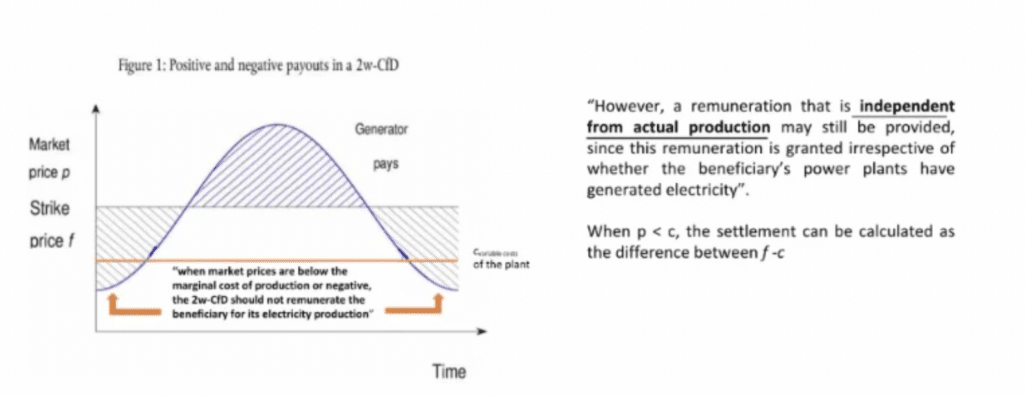
Guillaume Dezobry further emphasised that, under certain circumstances, the nuclear operator will not – should not – follow the price signal described in the Commission’s Guidelines.
Firstly, as emphasized in EDF’s technical report, in some situations, plants are operated following the « must-run » operating mode for safety reasons. During certain phases of the fuel cycle, a reactor must maintain its planned reactivity reduction trajectory and empty its core before the scheduled refuelling outage. As a result, operators may be required to continue injecting electricity into the grid even when market prices are negative. The fact that the European Commission’s guidelines provide no explicit exception for such nuclear safety constraints exposes operators to additional financial risks.
Secondly, when the remaining fuel is inusfficient for the plant to operate at full capacity until the next refuelling, it becomes economically rational to operate the plant taking into account the opportunity cost (or use value) of the remaining fuel. It follows that, in periods of exceptionally high electricity prices, if an operator anticipates even higher prices in the future, it will decide to withhold production as part of a value optimisation strategy. Under the current regulatory framework, the operator may still be required to transfer the difference payment to the state counterparty for a theoretical volume of electricity that was never actually sold, thereby creating a substantial liquidity risk.
Finally, these complex arbitrage decisions within a « hybrid » market model raise unprecedented legal questions under the European Regulation on Wholesale Energy Market Integrity and Transparency (REMIT)⁶. Mr Dezobry noted that the guidance issued by the Agency for the Cooperation of Energy Regulators (ACER) remains highly ambiguous regarding the legality of economically motivated withholding of nuclear generation capacity, leaving considerable regulatory uncertainty for operators.
Economic Analysis of CfDs and the Hybrid Market Framework : Fabien Roques
Fabien Roques, Executive Vice President at Compass Lexecon and Associate Professor at Université Paris-Dauphine, started his intervention that explaning that the state aid framework under which nuclear support packages in general and CfDs are assessed requires to identify first the specific market failures that state aid packages are intended to address.
He recalled the academic consensus that liberalised electricity markets perform efficiently in the short term—ensuring the economic dispatch of power plants according to their marginal costs—but there is a large literature that documents the challenges for power markets to provide adequate long-term investment signals that incorporate positive externalities. Carbon pricing alone is insufficient to internalise the value of low carbon technologies such as nuclear power with policy objectives to decarbonise, and to account for their contribution to security of supply or diversification of the electricity mix.
Furthermore, nuclear projects are capital intensive and feature long contruction and operating times, thus highlighting some of the challenges of capital markets to manage nuclear specific risks over very long time frames. These projects depend on a long-term, irreversible commitment from sovereign states. Consequently, the structure of public support cannot be limited to a simple revenue-based CfD: a nuclear support package typically entails other mechanisms besides the CfD, such as instruments to facilitate the long term financing of the program, such as state loans or public guarantees, as well as broader de-risking elements to address regulatory and policy risks and long term liabilities such as nuclear waste.
Fabien Roques identified several fundamental economic trade-offs in designing an efficient CfD and broader nuclear support framework:
– The need for an efficient allocation of risk : If comprehensive state-backed de-risking mechanically reduces the cost of capital and therefore the apparent cost of the programme for consumers, the risk itself does not disappear; it is transferred to public finances. The fundamental question is whether the macroeconomic cost of bearing this risk through the state is genuinely lower than if it were carried by the private sector.
– The Distribution of Costs Between Consumers and Taxpayers across time : The design of the nuclear support package also raises, from an economic point of view, important questions regarding their distribution between consumers and taxpayers across time. In particular, the financial flows associated with CfDs are typically directly passed through in consumers’ electricity bills, whereas public guarantees and subsidised loans are borne by the state budget and, therefore, by taxpayers. The design of the CfD and broader package also affects the time profile of the cost of the program, for instance in schemes where there are two successive strike prices.
– Contractual Resilience across time : Given the long investment horizon of 60 years, it is impossible to anticipate all future technological, policy and market evolutions and disruptions. In order to be resilient to these evolutions and schocks, contracts such as CfDs typically feature both a set of predetermined evolution mechanisms (such as indexation clauses), as well as review clauses (« reopening triggers ») in case of extraordinaty events.
– CfDs as part of a broader contracting policy : According to Fabien Roques, the widespread deployment of two ways CfDs for both nuclear and renewables is accelerating the emergence of a hybrid electricity market model in Europe, combining short-term market mechanisms for efficient dispatch with a layer of centralised contractual and state planning. The emergence of this new hybrid market model raises a number of design and implementation quesitons which are well documented in the literature⁷.
An important implication of the growing role of CfDs in European electricity markets is that the state or state body that is the offtaker of the CfD sees its financial counterparty exposed to basis risk—that is, the difference between the guaranteed strike price and actual wholesale market prices. This growing exposure and its potential impact on state budgets is likely to encourage governments to develop hedging instruments through e.g. back-to-back long-term contracts with major industrial consumers, such as power purchase agreements (PPAs), and/or defining a risks management strategy for spot and forward markets.
Panel Discussion 2 – Insights from the nuclear projects underway
The second panel discussion, moderated by Guillaume Dezobry, provided a concrete comparison of the three major nuclear projects currently under examination or deployment within the European Union: the Czech, Polish and French models. Charles Weymuller, Chief Economist of EDF, joined Laurent Kueny and Marcin Kaminski to present the detailed architecture of these state aid contracts.
The Evolution of the Polish Model Towards an Exogenous Approach
Asked about the development of the Polish notification approved last December, Marcin Kaminski explained the methodological adjustments required by the Directorate-General for Competition.
Initially, Poland had proposed a sophisticated mechanism known as the « Load Factor Strike Price Adjustment Mechanism« . This model aimed to mathematically project the future impact of renewable energy penetration on the electricity system and dynamically adjust the strike price according to the actual load factor achieved by nuclear reactors, taking into account that reactors would shut down during periods when electricity prices fell below their variable operating costs.
However, under pressure from the European Commission and in order to comply strictly with the obligation to respond efficiently to market signals, this approach was abandoned in favour of a non-production-based CfD built around an exogenous reference volume. This reference volume is determined normatively on the basis of the reactor’s theoretical maximum or average technical capacity, corresponding to the quantity of electricity that the plant could theoretically market in advance through forward markets.
As a result, the financial flows associated with a CfD become entirely decoupled from the plant’s real-time dispatch decisions. The Polish operator therefore retains full incentives to optimise production on the spot market through arbitrage strategies. If short-term prices fall below variable operating costs, the operator has a strong incentive to halt production and purchase the required electricity directly on the spot market to fulfil previously contracted forward obligations, thereby capturing the resulting margin.
The French Model: Decoupling Base and Shape Value
Regarding the French project involving the construction of six EPR2 reactors, Charles Weymuller presented the technical architecture submitted to the European Commission, describing it as a major milestone in the development of hybrid electricity market design.
The French model relies on a sophisticated distinction between two components of electricity value:
– the « base load leg« , corresponding to the stable, long-term value of electricity production;
– the « shape value« , reflecting the value associated with hourly and seasonal price variations.
The underlying principle is to shield EDF from long-term macroeconomic risks while maintaining its full exposure to short-term market volatility, thereby preserving incentives for operational optimisation.
Under this model, the French state provides financial support through the base load leg: transfers under the two-way CfD are indexed exclusively to annual average price parameters and theoretical reference volumes based on a baseload production profile.
Conversely, EDF remains fully exposed to the shape value, namely the hourly and intra-annual price fluctuations generated by renewable intermittency and demand peaks. If EDF successfully optimises maintenance schedules, refuelling operations and hourly production modulation, it retains all associated gains from these price spreads; equally, it bears all resulting losses.
Mr Weymuller explained that the model operates across three distinct time horizons:
– Short-term (hourly scale) : The operator incorporates all technical and safety constraints into its bids on wholesale electricity markets, including day-ahead, intraday and balancing markets.
– Medium-term (annual scale) : The CfD fulfils its role as a macroeconomic stabiliser by smoothing revenues according to the annual average price of low-carbon electricity.
– Long-term (five-year horizon) : The contract includes a mandatory review clause every five years, allowing the technical and financial parameters of the reference volume to be reassessed and recalibrated according to the actual evolution of the European electricity mix, thereby preserving the principle of equitable risk-sharing.
The Czech Repayment and Refinancing Model
Discussing the Czech Republic’s ongoing notification procedure for the extension of the Dukovany nuclear power plant (Units 5 and 6), Fabien Roques highlighted a particularly innovative feature distinguishing the Czech approach. The Czech project envisages two distinct contractual periods associated with two different strike prices over the lifetime of the CfD. This is an example of the intertemporal design choices embeded in the design of CfDs. Having two strike prices allows to differentiate across time the impact on consumer bills of the cost of supporting the nuclear program.
Industrial, Regional and Cross-Border Perspectives
The final part of the discussion focused on the need to broaden the analysis beyond strictly national boundaries. Guillaume Dezobry and Laurent Kueny identified a major contradiction within the current European framework: while physical infrastructure and wholesale electricity markets operate on a continental scale, state aid mechanisms and the financial risks associated with nuclear investment remain strictly confined to national budgets.
This situation generates obvious economic distortions and political tensions. For example, a country such as France or Poland that finances a large-scale nuclear programme through public funds or domestic consumers will, thanks to their stable production profile, reduce marginal electricity prices across the entire interconnected European wholesale market during periods of high production, thereby benefiting neighbouring countries directly. Yet these neighbouring countries bear none of the initial financial risks.
Mr Kueny therefore advocated the development of cross-border CfDs and PPAs. He referred to the experience of the 1980s, when France relied on cross-border contracts to attract foreign capital for financing its nuclear fleet⁸. Today, countries lacking suitable sites or pursuing different energy mixes—such as Italy—could directly co-invest in French nuclear programmes in exchange for long-term contractual access rights to the electricity produced.
To overcome these political obstacles, Professor Roques proposed a pragmatic approach based on the existing methodologies developed by ENTSO-E for sharing the costs and benefits of cross-border electricity infrastructure, particularly those currently applied to offshore wind projects in the North Sea.
A first step could involve directing European common funding mechanisms—such as structural and transition funds—towards nuclear projects by demonstrating scientifically their positive systemic externalities for the decarbonisation of the European Union as a whole.
Finally, Marcin Kaminski concluded on a note of cautious optimism by recalling the existence of a precedent in Central Europe: the Krško nuclear power plant project, whose production and costs have historically been shared by a treaty between two Member States, Slovenia and Croatia⁹. This arrangement constitutes a valuable legal precedent for the future development of cross-border CfDs.
Conclusion
Concluding this morning of intensive discussions, Christophe Béguinet, Member of the European Economic and Social Committee andof EDF’s Board of Directors, stressed that the role of European institutions such as the EESC is to make these highly complex issues accessible to all stakeholders, including trade unions, consumer associations and industrial representatives. If citizens and policymakers fail to master the technical language of reference prices, load modulation and capital cost structures, Europe risks making strategic decisions based on outdated assumptions.In this regard, the concept of a hybrid electricity market, capable of reconciling the long-term state planning required for capital-intensive industries with short-term wholesale market mechanisms, appears increasingly to represent the only realistic pathway towards decarbonising the European economy without undermining its industrial base and the millions of jobs that depend upon it.